Tuesday, June 22, 2010

Book tip: Computing the mind

I'd like to discuss why, without having finished the book yet, I hand over heels love the book: Computing the mind, subtitled "How the mind really works", by Shimon Edelmann. I have to admit that I didn't have the highest hopes when I opened the book. I went so far as to skip the first couple of pages, to get to the fun parts a bit quicker. As I write these blog post, page 1 lies open on my desk, and it's the most beautiful start a non-fiction book could hope to offer:

If you are reading this in the first couple of decades of the third millennium of the common era, chances are that (1) the human brain is the most complex toy you'll ever come near, let alone get to play with, and (2) you're trapped inside one for the foreseeable future.


And then, on page 78, we get this teaser for what's to come later:
Claim: the brain is a programmable digital computer. If this were true, the brain would be like hardware to the mind's software. This claim does not stand up to scrutiny, mainly because in the brain it is not possible to separate the "program" from the architecture that executes it. It is very important to remember, however, that a digital computer can simulate the operation of a brain (because a digital computer can simulate any physical system down to an arbitrary precision), and hence the mind. The ramifications of the realization that the mind is what the brain does are far-reaching and profound; I shall describe and discuss them in later chapters.


He had me long before page 78, though. He quotes Karl Popper throughout the book. This book is amazing in clarity, it's funny, and it's mind-opening.

Sunday, May 23, 2010

Friendly advice from Eric S Raymond

My favorite quote from "The cathedral and the bazaar," p. 207:

If you're attracted to hacking because you don't have a life, that's okay too---at least you won't have trouble concentrating. Maybe you'll get a life later on.


I love the book, but I think the first two essays would have been enough to read, that's "The cathedral and the bazaar" and "homesteading the noosphere." The others are far from neutral and not full of insight like the first two. The first two are an insightful analysis of the psychology and culture of hackerdom.

Tuesday, May 4, 2010

The burden of the reviewer

The paper I'm reviewing treats an interesting topic without much love. I'm getting sick of reading other people's papers. If this goes on, I'll just write my own papers.

By the way, I'm still taking really long for reviewing. An hour of work and I'm on page … 2.

Thursday, March 25, 2010

Git tree objects, how are they stored?

A git tree is git’s internal representation for directories. Trees have entries which are either trees themselves, or blobs.

The general format is: First 4 bytes declaring the object type. In our case, those four bytes are “tree”, ASCII-encoded. Then comes a space, and then the entries, separated by nothing.
The exact format is the following. All capital letters are “non-terminals” that I’ll explain shortly.
    tree ZN(A FNS)*

where

  • N is the NUL character

  • Z is the size of the object in bytes

  • A is the unix access code, ASCII encoded, for example> 100644 for a vanilla file.

  • F is the filename, (I’m not sure about the encoding. It’s definitely ASCII-compatible), NUL-terminated.

  • S is the 20 byte SHA hash of the entry pointed to, 20 bytes long.

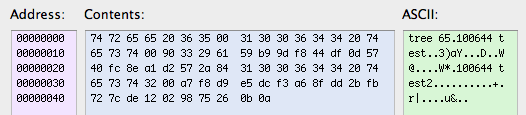
Here’s an example. Say we have a directory with two files, called test and test2. The SHA of the directory is f0e12ff4a9a6ba281d57c7467df585b1249f0fa5. You can see the SHA-hashes of the entries in the output of
    $ git cat-file -p f0e12ff4a9a6ba281d57c7467df585b1249f0fa5
    100644 blob 9033296159b99df844df0d5740fc8ea1d2572a84    test
    100644 blob a7f8d9e5dcf3a68fdd2bfb727cde12029875260b    test2


(To reproduce this, the file test should contain the ASCII-encoded characters “hallo” (not \n-terminated), the file test2 should contain the ASCII-encoded characters “bla\n” (yes, \n-terminated)).

That is converted into the following object (uncompressed):


Finally, the file is deflated and stored on disk. For deflation, zlib is used. For my experiments I used the ruby zlip package. The following tiny script reads the tree from disk and inflates it, so you can look at it:

    require 'zlib'
    require 'fileutils'
    File.open("objects/f0/e12ff4a9a6ba281d57c7467df585b1249f0fa5") { |f|
        puts Zlib::Inflate.inflate(f.read)
    }

Saturday, March 20, 2010

You can't cast Object[] to String[] in Java

Consider this snippet:
String[] str = (String[]) new Object[] { "Bla!"};.
That gives a ClassCastException. The short version of an explanation: an array instantiated by new Object[] is of a different class than one by new String[]. For the full glory of that fact, please see the Java Language Specification. As a teaser, I'll quote this snippet and its output from it:

class Test {
public static void main(String[] args) {
int[] ia = new int[3];
System.out.println(ia.getClass());
System.out.println(ia.getClass().getSuperclass());
}
}

which prints:
class [I
class java.lang.Object.

Thursday, March 18, 2010

Thick tech books

James Hague:
"In order for a book to sell," said my publisher, "it's got to be thick. 600 pages thick."


Well, that about explains why tech books suck so badly.